

Last Updated: October 30, 2026
Quick Summary
Severe muscle pain is intense discomfort in a muscle or muscle group that limits how you move, ranging from a sharp, localised ache after a hard workout to widespread pain signalling underlying illness. Most cases settle with home care such as relative rest, ice or heat, but pain that worsens, brings new symptoms, or has not clearly improved by day seven needs medical advice.
- Myalgia is the medical term for muscle pain, from mild ache to pain that stops you lifting your arm.
- Use ice wrapped in a towel for 15 to 20 minutes at a time during the first 24 to 48 hours.
- Most muscle pain should be clearly better by day seven, even if not fully gone.
- Return to activity at around 50 per cent of your previous volume or intensity for the first session or two.
Table of Contents
- What Severe Muscle Pain Actually Feels Like
- Muscle Pain Causes: From Hard Workouts to Underlying Illness
- How to Relieve Sore Muscles at Home
- How Long Do Sore Muscles Last?
- Muscle Pain or Nerve Pain: Telling Them Apart
- Red Flags: When Severe Muscle Pain Needs a Doctor
- Frequently Asked Questions
What Severe Muscle Pain Actually Feels Like
Severe muscle pain is intense discomfort in a muscle or muscle group that limits how you move, from a sharp, localised ache after a hard workout to widespread pain signalling underlying illness.
According to National Centre for Health Statistics data on chronic pain in U.S. adults, 24.3% of US adults had chronic pain in 2023, and 8.5% had pain that frequently limited life or work.
Muscle tenderness, weakness and the signs that matter
Myalgia is the medical term for muscle pain, covering everything from a mild ache to pain that stops you lifting your arm.
Here is what separates ordinary soreness from something more serious:
- Tenderness when you press the sore area
- Weakness that makes everyday tasks hard
- Fatigue that comes with the pain
A common mistake is assuming all muscle pain is minor. Cleveland Clinic's overview of myalgia notes that muscle pain is usually temporary and not serious, but can sometimes signal a long-term condition. Mayo Clinic's guidance on muscle pain agrees that pain from severe injuries or health conditions can be serious and needs medical care.
Muscle Pain Causes: From Hard Workouts to Underlying Illness
Muscle pain causes fall into two groups: strain from activity, and pain driven by illness or other body-wide problems. Knowing which group you sit in changes what you do next.
Activity-related causes are the ones most people recognise:
- Exercise and hard workouts, especially new or intense sessions
- Delayed-onset muscle soreness (DOMS), the ache that peaks a day or two later
- Muscle strain from lifting, twisting or sudden effort
- Repetitive work, common in trades and manual jobs
The illness group is where things get more serious:
- Systemic infection, such as flu or COVID, which often brings muscle aches with fever
- Chronic illness, including thyroid problems and autoimmune conditions
- Fibromyalgia, which causes widespread pain and tender points
A review in the journal Pain and Therapy on managing musculoskeletal pain reports that muscle hyperalgesia, referred pain and widespread hyperalgesia play important roles in chronic musculoskeletal pain. In plain terms, the nervous system itself becomes part of the problem.
Medication, dehydration and heat illness
Three causes catch people out because they do not feel like an injury.
Medication. Statins and some other drugs can cause muscle pain.
Dehydration. Low fluid levels and low electrolytes can contribute to cramps and muscle aches. A magnesium supplement may support normal muscle function.
Heat illness. Heavy work in hot conditions can cause cramping and severe muscle pain. Stop, cool down and hydrate.
How to Relieve Sore Muscles at Home
How to relieve sore muscles comes down to a simple order: protect the area, calm the pain, then return to gentle movement. Most cases settle with home care.
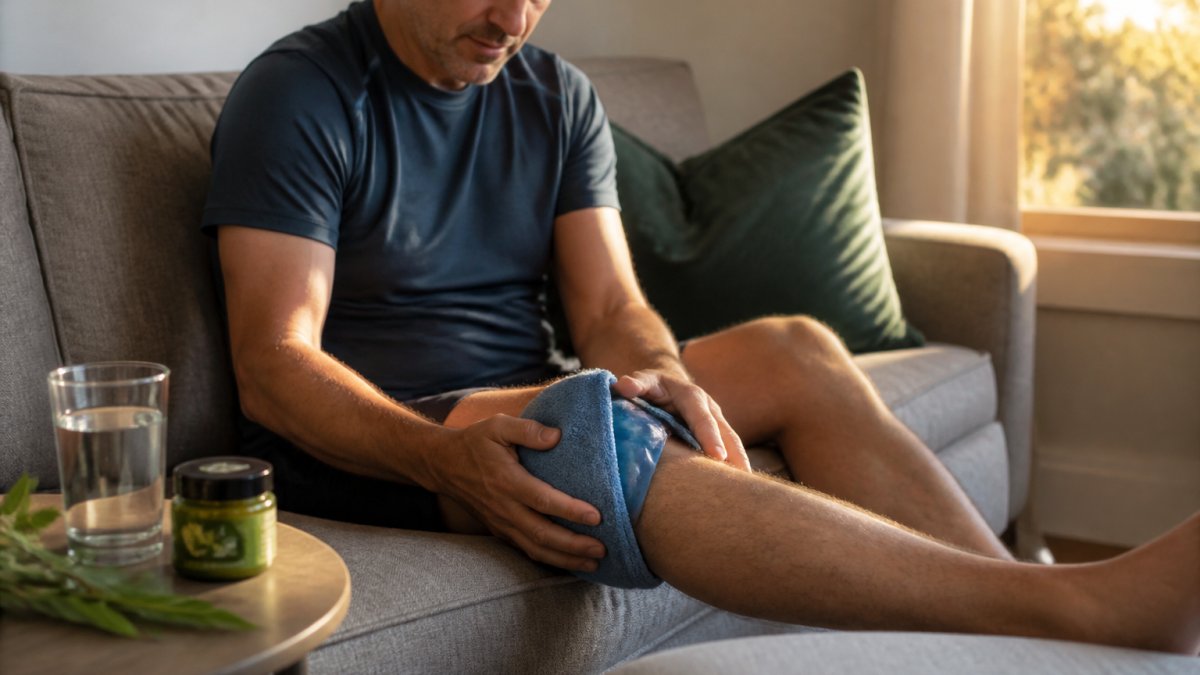
The American College of Physicians and American Academy of Family Physicians guideline on acute musculoskeletal pain lists superficial heat, massage, acupuncture and spinal manipulation as initial treatment options for adults with acute pain from non-low-back musculoskeletal injuries.
Here is a practical home routine:
- Rest and relative rest. Avoid the movement that caused the pain, but do not lie still for days. Gentle movement helps.
- Ice or a cold pack for the first 24 to 48 hours, wrapped in a towel, for 15 to 20 minutes at a time.
- Heat therapy after the first couple of days, or for stiffness and tension.
- Gentle stretching once the sharp pain fades.
- Massage and foam rolling to ease tight spots.
- Compression and elevation for swelling.
- An over-the-counter muscle or joint rub, such as X-ZONE.
Ice, heat and relative rest
The old RICE rule has been overtaken by relative rest: keep moving gently rather than stopping completely. Warming the area first helps too. Many people find warmth useful for preparing sore muscles, and a topical rub can be applied directly to the affected area.
Watch out: ice placed directly on skin can cause a cold burn. Always wrap it in a towel first.
How Long Do Sore Muscles Last?
Recovery time depends far more on the cause than on how severe the pain feels on day one. A hard workout and a statin reaction can both produce severe muscle pain, but they behave very differently over the following week. Use the timelines below as a guide, and treat 'not progressing' as its own warning sign.
Cause |
Typical recovery |
What helps |
Signs it is on track |
|---|---|---|---|
DOMS after a hard or new workout |
Peaks at 24-48 hours, eases within 48-72 hours, usually gone within a week |
Relative rest, gentle movement, heat after the first 48 hours |
Pain eases each day after the peak; full strength returns |
Mild muscle strain (grade I) |
A few days to two weeks |
Ice first 24-48 hours, then heat; avoid the provoking movement |
Pain-free walking and light use within a week |
Moderate strain or bruising |
Two to six weeks |
Cold packs early, compression, elevation, graded return |
Swelling settles, range of movement improves weekly |
Systemic infection (flu, COVID) |
Follows the illness, often one to two weeks |
Rest, fluids, medical advice if worsening |
Aches fade as fever and other symptoms resolve |
Medication-related muscle pain |
Variable; needs medical review |
Report to prescriber; do not stop prescribed medicine unsupervised |
Pain improves once the cause is addressed |
Heat illness or dehydration |
Hours to a couple of days with cooling and fluids |
Stop activity, cool down, rehydrate with electrolytes |
Cramps settle and urine returns to normal colour |
Signs recovery is not progressing
Most muscle pain should be clearly better by day seven, even if it is not fully gone. Seek advice if:
- Pain is worse at one week than it was at day two or three.
- Weakness is increasing rather than easing.
- Swelling, redness or heat in the area is spreading.
Returning to activity safely
A practical rule is to return at around 50 per cent of your previous volume or intensity for the first session or two, then build by roughly 10 per cent per week. Warm up before loading the muscle, keep hydrated, and avoid repeating the exact session that caused the pain until soreness has settled. For a fuller routine, read our guide to the art of warm-up and recovery.
Muscle Pain or Nerve Pain: Telling Them Apart
Muscle pain or nerve pain is the question to settle before you treat anything, because the two need different approaches. Muscle pain is dull, achy and felt in the muscle itself. Nerve pain is sharp, burning or electric, and it travels.
Use these clues:
- Muscle pain: tender to touch, worse after use, eases with rest and heat
- Nerve pain: tingling, numbness, pins and needles, shooting pain down a limb
- Location: muscle pain stays in the muscle; nerve pain follows a path
Nerve pain that spreads, causes numbness or comes with weakness in a limb needs a doctor, not a rub.
Red Flags: When Severe Muscle Pain Needs a Doctor
Most muscle pain is not an emergency. Athletes checking whether herbal topicals are safe under anti-doping rules can read our guidance on anti-doping regulations. But severe muscle pain can be the first sign of a condition that needs urgent assessment, and the difference between 'rest it and see' and 'call 111' is usually a small number of associated symptoms rather than the pain score alone.
Call Emergency Services or go to A&E immediately.
Seek emergency help if severe muscle pain comes with any of the following:
- Chest pain, shortness of breath, or pain spreading to the jaw, neck or arm. Muscle pain is not usually a heart symptom, but with these signs it must be treated as a possible cardiac event until proven otherwise.
- Dark, cola-coloured urine, very little urine, or pain after a fall, crush injury or prolonged immobility. This can indicate rhabdomyolysis, where damaged muscle releases proteins that can threaten the kidneys. It is uncommon but time-critical.
- Sudden weakness, numbness, or loss of bladder or bowel control, especially with back pain. This can signal nerve compression that needs urgent assessment.
See a doctor within 24 to 48 hours
Book urgent same-day or next-day advice if you have:
- Muscle pain after starting a new medication, particularly a statin, or after a dose increase. Do not stop a prescribed medicine without advice, but report the pain promptly.
- Pain that is rapidly worsening over hours rather than days, or far out of proportion to the activity you did.
- New weakness that makes everyday tasks, climbing stairs, lifting a kettle, rising from a chair, difficult.
Book a routine appointment
See your GP in the normal way if:
- Pain has not improved after one to two weeks of sensible self-care.
- Pain keeps returning with the same activity.
- You have widespread pain, tender points, or fatigue that suggests a longer-term condition such as fibromyalgia or a thyroid problem.
The ISMuLT guidelines for muscle injuries aim to reduce uncertainty and variation in how muscle injuries are managed, which is why a proper assessment matters for anything beyond mild soreness. For everyday soreness, you can explore natural relief options on our website.
Frequently Asked Questions
What can cause severe muscle pain?
Severe muscle pain can follow a hard workout, a strain or a fall, but it also has medical causes. Dehydration, heat illness and some medications can trigger it, and systemic infection or chronic illness such as fibromyalgia may be behind widespread pain. A 2021 review in Pain and Therapy notes that muscle hyperalgesia and referred pain play important roles in chronic musculoskeletal pain. If pain arrives with fever, swelling or muscle weakness, get it checked rather than treating it at home.
How can I relieve severe muscle pain at home?
Start with relative rest rather than total bed rest, then apply a cold pack for the first 48 hours and switch to heat therapy once swelling settles. Gentle stretching, massage and over-the-counter painkillers can help, and gentle massage can ease discomfort for many people. Topical products can be used as part of a self-care routine. Seek medical advice if pain worsens after a few days.
How long do sore muscles last after exercise?
Delayed-onset muscle soreness, or DOMS, usually peaks between 24 and 72 hours after a hard workout and eases within a few days to a week. It is a normal response to unfamiliar exercise and improves with light movement, hydration and rest. Pain that lasts beyond a week, gets sharper rather than duller, or comes with swelling and dark urine is not ordinary soreness and needs medical assessment.
How can I tell the difference between muscle pain and nerve pain?
Muscle pain tends to sit in a specific sore area and feels like tenderness or ache that worsens when you use the muscle. Nerve pain often travels along a limb, stings or burns, and may bring tingling, numbness or muscle weakness. If you cannot put weight on the limb, lose sensation, or the pain shoots down an arm or leg, treat it as nerve pain and see a doctor. A physiotherapist can assess which tissue is involved.
Muscle pain that lingers or limits your movement deserves proper care, but everyday soreness does not have to slow you down. X-ZONE New Zealand makes plant-powered relief with 11 native New Zealand herbs, independently tested to reduce inflammation by up to 54%. Our Sports and Relief ranges comes as a rub, spray or roll-on for fast, targeted relief, and it is vegan and cruelty-free. Get started with X-ZONE New Zealand and soothe sore muscles the natural way.
